|
Hotel |
 |
|
|
 |
|
Restaurants |
|
|
|
|
|
Cities |
|
|
|
|
|
eShop |
|
|
|
|
|
Look at... |
|
|
|
|
|
PISA Tourist Guide and Informations
In this page:
|
Piazza del Duomo
|

|
|
 Known as the "Campo dei Miracoli" because of the extraordinary monumental beauties that are located here, this is the largest architectural complex of Romanesque Europe. Of course any visit must begin with the celebrated Leaning Tower, the unique belltower of the Duomo. Its construction began in 1173 but had to be interrupted because the ground was giving way, which then lead to its exceptional tilt. In the 14th century, Giovanni de Simone finished the work with the creation of the Bell Room. It is about 56 meters high and is inclined in relation to the vertical by 4 meters. Cylindrical in structure, it has six rows of loggia and a row of blind arcades on the lower floor posed on semi-columns. Known as the "Campo dei Miracoli" because of the extraordinary monumental beauties that are located here, this is the largest architectural complex of Romanesque Europe. Of course any visit must begin with the celebrated Leaning Tower, the unique belltower of the Duomo. Its construction began in 1173 but had to be interrupted because the ground was giving way, which then lead to its exceptional tilt. In the 14th century, Giovanni de Simone finished the work with the creation of the Bell Room. It is about 56 meters high and is inclined in relation to the vertical by 4 meters. Cylindrical in structure, it has six rows of loggia and a row of blind arcades on the lower floor posed on semi-columns.
 The Tower is situated behind the Duomo, which is considered to be the most important expression of Pisan Romanesque. Its construction was begun by Buscheto in 1064 and completed by Rainaldo in the 12th century. The facade is articulated on the lower level with arches and on the upper level with four rows of loges. On its bronze doors the stories of the Madonna and Christ are incised. The door called "San Ranieri" opens onto the side facing its belltower. Inside the five naves are collected works of immeasurable value: paintings by Beccafumi, by Ghirlandaio, by Andrea del Sarto and by Sodoma. The mosaic in the apse is by Cimabue, the pulpit, a masterpiece of Italian Gothic art, is by Giovanni Pisano, and the central altar is by Giambologna. Finally, in front of the apse hangs Galileo's lamp, which was used by the famous scientist to determine important laws of physics. The Tower is situated behind the Duomo, which is considered to be the most important expression of Pisan Romanesque. Its construction was begun by Buscheto in 1064 and completed by Rainaldo in the 12th century. The facade is articulated on the lower level with arches and on the upper level with four rows of loges. On its bronze doors the stories of the Madonna and Christ are incised. The door called "San Ranieri" opens onto the side facing its belltower. Inside the five naves are collected works of immeasurable value: paintings by Beccafumi, by Ghirlandaio, by Andrea del Sarto and by Sodoma. The mosaic in the apse is by Cimabue, the pulpit, a masterpiece of Italian Gothic art, is by Giovanni Pisano, and the central altar is by Giambologna. Finally, in front of the apse hangs Galileo's lamp, which was used by the famous scientist to determine important laws of physics.
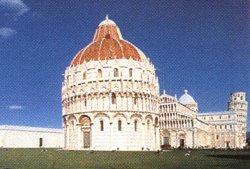 In front of the Duomo rises the impressive circular Baptistery, with a grandiose dome 18 meters in diameter. Diotisalvi began the construction in 1152 but it was completed only in the 14th century. One enters the Baptistery by way of four richly decorated doors. Within we find the baptismal font made by Bigarelli in 1264 and the pulpit by Nicola Pisano, made in 1260. This is a perfect example of late Romanesque Tuscan sculpture. In front of the Duomo rises the impressive circular Baptistery, with a grandiose dome 18 meters in diameter. Diotisalvi began the construction in 1152 but it was completed only in the 14th century. One enters the Baptistery by way of four richly decorated doors. Within we find the baptismal font made by Bigarelli in 1264 and the pulpit by Nicola Pisano, made in 1260. This is a perfect example of late Romanesque Tuscan sculpture.
The fourth monument of the "Campo dei Miracoli" is the Cemetery, next to the Baptistery and the Duomo. Giovanni di Simone began its construction in the 1200’s. This is a rectangular marble enclosure surrounded by a portico with blind arcades. It contains an exceptional collection of Roman, medieval and Renaissance antiquities. Among the funeral monuments the most notable are those of Arrigo VII, Pietro Ricci and Count Mastiani. There are many sculptures, detached frescoes and sinopie (sketches in a reddish-brown pigment brought from Sinope on the Black Sea). A trip to the Piazza of the Duomo ends with a visit to the Sinopie Museum and the Museum of the works of the Duomo.
|
|

|
S. Caterina
|
|
|
Going from the Piazza of the Duomo towards via Maffei, passing the Roman baths, we arrive at the via Santa Caterina and the church of the same name. Built in the 13th century, it has a marble facade broken up by loggia.
Inside we find a group of sculptures by Nino Pisano and a Madonna by Fra’ Bartolomeo. The belltower is embellished with works by Giovanni di Simone.
|
|
|
Piazza dei Cavalieri
|
|
 Returning to via Carducci and turning down via Consoli di Mare, we arrive at Piazza dei Cavalieri. Once it was the center of the Republican city. In the 1500s Vasari transformed it into the headquarters of the Order of the Knights (Cavalieri) of Santo Stefano. Here one finds the Palace of the Cavalieri, headquarters of the Scuola Normale of Pisa, the Church of S. Stefano and the Palace of the Orologio (clock), where Count Ugolino della Gherardesca was imprisoned and condemned to die of starvation, as narrated by Dante in the Divine Comedy.. Returning to via Carducci and turning down via Consoli di Mare, we arrive at Piazza dei Cavalieri. Once it was the center of the Republican city. In the 1500s Vasari transformed it into the headquarters of the Order of the Knights (Cavalieri) of Santo Stefano. Here one finds the Palace of the Cavalieri, headquarters of the Scuola Normale of Pisa, the Church of S. Stefano and the Palace of the Orologio (clock), where Count Ugolino della Gherardesca was imprisoned and condemned to die of starvation, as narrated by Dante in the Divine Comedy.. |
|
|
Piazza S. Francesco
|
|
| From the Piazza dei Cavalieri, by way of via Dini and via S. Francesco, we arrive in the Piazza S. Francesco. The church of the same name is from 1211, but has undergone various reworkings. The facade is from 1603. Of particular interest is the Room of the Chapter of S. Buonaventura, containing numerous frescoes made by NiccolÚ di Pietro Gernini in 1392. |
|
|
Lungarno Mediceo (Medicean River Walk)
|
|
|
 Following via de Simone, we arrive at Lungarno Mediceo, with its Romanesque San Matteo Church, the Palace of the Medici, and the National Museum of San Matteo, which is housed in the Benedictine Monastery. Among the important works are a group of paintings from the 12th to 18th centuries and a rich collection of sculpture from the Pisano School. Following via de Simone, we arrive at Lungarno Mediceo, with its Romanesque San Matteo Church, the Palace of the Medici, and the National Museum of San Matteo, which is housed in the Benedictine Monastery. Among the important works are a group of paintings from the 12th to 18th centuries and a rich collection of sculpture from the Pisano School.
|
|
|
San Paolo a Ripa d'Arno
|
|
|
The foundation of this church is from the year 805, but the building was rebuilt after being damaged during the last war. The interior, which is in the form of a basilica, contains a Madonna with Child painted by Turino Vanni in 1397. In the Chapel of Sant’ Agata we find remnants of frescoes dating from the 12th century. The Chapel itself dates from the same period. It has an octagonal base and tall spires.
|
|
|
S. Maria della Spina
|
|
|
Alongside Lungarno Gambacorti we find the Church of S. Maria della Spina, a masterpiece of Pisan Gothic art. It is the enlargement of an oratory dedicated to S. Maria de Pontenuovo, built entirely in marble and decorated in arcades, spires, kiosks, and peaks. The facade is embellished with tondi (sculpted circles) and rosone (rose medallions). This church has not always been on the site where it is today. At first it rose on the gravel bed of the river. In the 1800’s it was taken apart and transferred because it was endangered by the many infiltrations of water that were destroying it.
|
|
|
Logge di Banchi
|
|
|
In Piazza XX Settembre, in front of the Ponte di Mezzo ("Middle Bridge"), is the Logge di Banchi, built by Cosimo Pugliani, probably according to the plans of Bernardo Buontalenti, at the beginning of the 1600’s, when it was used as a public market for wool and silk. The upper floor was built later, at the beginning of the 18th century.
|
|
|
Cittadella Nuova
|
|
|
Leaving the Lungarno along the via S. Martino, one arrives at the Cittadella Nuova (New Fortress), built by the Florentines in the 1400’s to assure their control over the city. It was destroyed by the Pisans and then again rebuilt by the Florentines in the 1500’s, according to the plans of Giuliano da Sangallo. In 1798 Domenico Scotto transformed it into a garden.
|
|
|
|