
Italian Tourist Web Guide ? 1996/97 by ITWG.COM
(Provided by Azienda di promozione turistica del Trentino)
 Back to Castles Index
Built on enormous rocks that slid down from the Cengio Rosso above, Castel Pietra stands at the foot of the Castel Beseno hill, beyond the Rio Cavallo.
In an important strategic position, it marked for many years the border between the Venetian Republic and the Episcopal Principality of Trento and also between the latter and the Italian Tyrolean territories. Many important field battles were waged around Castel Pietra, especially in the fifteenth and sixteenth centuries when the Venetians tried to move north against the principality and the Austrians.
Memorable sieges took place in May 1413 and on 25 July 1487, before the Venetians were defeated on 19 August at Calliano with the death of Roberto Sanseverino. The walls of the fortress still bear the signs of the last great battle between the Austrians and the French in the autumn of 1796. In former times a strong battlemented wall, the Murazzo, stretched from the castle down to the river Adige, whose water lapped against it, thus barring the imperial road.
Pietra was always a fort and never had a real jurisdiction. Nevertheless, inside it, there are some interesting profane frescoes of the fifteenth century decorating the great hall with mysterious medieval figures. The old castle virtually incorporates the enormous rock on which it was built. Among the most noteworthy parts of it, besides the great hall, are the armouries, flights of stairs with mechanisms controlling the iron door of the Murazzo and a gloomy cellar where, according to legend, the prisoners forced to turn the mill-wheel lived. In the eighteenth century the bastions were turned into a small elegant residence still inhabited today.
Location: close to (east) the Brenner 12 State road, 1 km south of Calliano
Information: Tel. 0464/430363
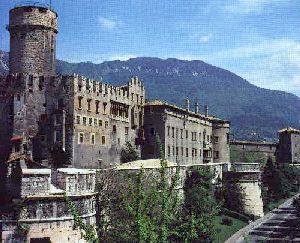 Castello del Buonconsiglio was built by Sodegerio di Tito, judge and podesta of Trento for Emperor Frederick 11 between 1239 and 1255. The rocky mound, on which the first settlements stood, was called Malconsiglio (a Latin corruption of the Germanic mallum: "public meeting place"). The massive tower (45 metres high and 12 wide), which according to local tradition was originally Roman hence its name Augustus Tower, already existed.
Backing onto the town walls the castle consists of two main units: one is the medieval "Castelvecchio" built in Romanesque-Gothic style and the other is the Renaissance "Magno Palazzo". In the former, built around an early medieval tower, can be seen the various stages of subsequent elevations: from the Romanesque battlemented curtain wall above the portal with the drawbridge, to Bishop George of Liechtenstein's fourteenth century windows with a stone cross and the Gothic loggia made by Bishop Hinderbach in the late fifteenth century. One of the most important international Gothic masterpieces, the famous "Cycle of the Months", was painted by a Bohemian artist, Wenceslaus, in the Aquila Tower, one of the gate houses of the city. It is a cultural testimony of European value that blends the experience of the Bohemian-Viennese and VeroneseLombard cultures.
In 1528, Bernardo Clesio, one of the most important Tridentine prince bishops, began the impressive construction of the new wing, the Magno Palazzo. Many and famous artists worked on it leaving masterpieces on the vaults, ceilings and walls of the palace. To mention but a few, the frescoed cycles of illustrious Venetian painters such as Fogolino, Gerolamo Romanino (the loggia and Lions' Courtyard) and the Dossi brothers. The walls of the "Chamaron del torion de sora", today the Hall of Mirrors, was hung with seven precious Flemish tapestries bought by Clesio in Cologne, in 1531, for a thousand gold ducats.
Clesio was succeeded by Cristoforo Madruzzo under whom the Council of Trent was held in the principality. This extremely important event marked the most illustrious period in the history of the city. Feasts never seen before and sumptuous ceremonies were organised in the castle halls and attended by the leading European figures of the period. In the nineteenth century the castle fell rapidly into neglect, until it became the symbol of Italian irredentism following the execution of Damiano Chiesa, Cesare Battisti and Fabio Filzi in 1916.
Location: In Trento, at the foot of the cervara hill, entrance in via Bernardo Clesio. Open all year, closed on Mondays.
Information: Tel. 0461/233770
VALSUGANA AND PRIMERO
lvano is the first castle one comes to travelling from Bassano to Trento along the Valsugana. Its square keep with a pointed roof stands out on the top of the hill dominating Ivano Fracena. At midday it looks like a graceful and elaborate complex nestling in the wood. From the north its high bare walls leave no doubt as to its medieval origin and military function.
The history of Ivano begins with an 1187 document that mentions Jacopino d'lvano as the witness of an investiture. The subsequent medieval events of the castle are extremely turbulent, as can be seen by the two armorial bearings on the roof of the keep, belonging to the Della Scala and the Carrara of Padua. The layout of the square keep is medieval, Romanesque with Gothic insertions, now between the "palazzo di qua" and the "palazzo di ld", fifteenth reconstructions of older buildings. Famous European artists stayed here in the eighteenth and nineteenth centuries: Wagner "di qua" and Eleonora Duse "di la ". The external castle walls, organised in semicircular bastions, date back to the fourteen and fifteen hundreds when Ivano was also involved in the fierce dispute between Venice and the Austrian dukes.
In the 17th century the castle returned to Tyrolean hands. In 1679 Maria Teresa gave it to the Wolkensteins as a perpetual trust. They sold it, by then reduced to ruins by the bellicose events, just after the war. The rooms in the tower and the dungeons evoke a feeling of mystery and awe. But so do the inner wards, among the walls, and the loggias overlooking the valley. As one walks towards the outside of the complex, the stables and other buildings, added between 1500 and 1700, still give the impression of a busy livelyvillage, in an unusual "inhabited" atmosphere, intensified by the wealth of flowers and vegetation.
Location: from the Valsugana 47 state road to Barricata di Sopra, where you take the Tesino 78 provincial road towards Strigno.
Just after the village turn right into the Ivano and Ospedaletto 60 provincial road.
After 1 km you reach Ivano from where it is a short walk to the castle.
Information: Tel. 0461/763432
Castello di Pergine, a typical fortified alpine manor of severe medieval appearance, has remained more or less pristine in its basic form, unlike nearly all the other castles in Trentino which are a combination of various styles. The reason for this is soon explained. Apart from the beginnings of its history, the castle has always been government property, at times Tyrolese and at others episcopal, who kept their constables there.
The basic Gothic reconstruction on a previous Romanesque plan, and prior to that a hillfort, was always respected because the various deputies, vicars and functionaries were in temporary residence and so had no interest in making costly or radical alterations to the place.
Today, Castello di Pergine is a beautiful example of a medieval alpine fortress cum residence, with a system of walls and towers surrounding the top of Tegazzo hill, above the town. It is dominated by the solid vertical bulk of the lord's residence of obvious Gothic style. Its origin is mysterious and in the historians' opinion it was built in Longobard times. It was kept by the local nobles until 1270 when Pergine fell into the hands of the counts of the Tyrol. The Tyrolean domination lasted until 1513, when Cardinal Bernardo Clesio, Prince Bishop of Trento, acquired jurisdiction over the area and the castle.
The German builders who worked there left a striking example of Gothic style, so that the castle evokes an unusual atmosphere for Trentino fortified manors: pillars, groins, ribs, ogival arches. The hall of arms is a good example. It is a large spectacular room with a huge octagonal pillar supporting a cross vault. The impression of a cathedral is completed by eight half pillars and six ogival and round arch doorways. On the mezzanine floor, a typically medieval place, there is the frightening dungeon of the "torture of the drip". On the first floor the Gothic chapel of Sant'Andrea.
Location: from Pergine along the 228 provincial road towards Levico, turn left at Masetti following the signs.
Open from May to October
Information: Tel. 0461/531158
VALLI DEL NOCE
The Thuns were one of the most important families in Trentino in the past centuries. They were very wealthy and could lend money to emperors and bishops and theywere particularlyprolific so there was no fear of them dying out. The Thun family settled in Castello di Belvesino, at the entrance to Valle di Non, towards the end of the 13th century. In time they turned the simple primitive stronghold into the present sumptuous manor, now called Castel Thun.
Having prospered in the 1100s under its original name of Tono, the family reached the height of its glory in the 1 400s by extending its power over most of the Valle di Non andValle di Sole and naturallyover manycastles. In 1530, the Thuns obtained the title of baron, in 1628 that of counts of the Empire and, two years later, the Bohemian line was derived from the Castelfondo line, a branch of the Bragher one. The baronial residence soars vertically, with three Gothic turrets, high in the centre of the fortified system which towards the present entrance, the Spanish doorway, consists of five towers, a drawbridge and a deep moat. The curtain wall runs all around it and encloses the tournament field, the Basilian tower and the library tower, a room with a baroque stucco ceiling that houses ten thousand volumes and numerous incunabula.
Inside the castle there are a number of precious rooms which, in style and furnishings, reflect the eventful history of Castel Thun: the guardroom, the dining room, the room of the dead, a well supplied armoury and, on the first floor, the rooms of the lords' apartment. Among these, the room of the ancestors, the room of the fireplace, Louis XVI's drawing-room, the study, the playroom, the spinet room and the banquet room. On the second floor there is the most historical feature of the castle, the bishop's room, completely lined with pine wood, in which the last prince bishop of Trento, Pietro Vigilio, died.
Location: on the Anaunia 43 state road, at Castelletto turn right to Vigo di Ton. The castle lies 2 km along the 124 provincial road from Vigo in the direction of Toss.
Information: Tel. 0461/233770
The massive bulk of Castel Caldes overshadows the houses around it at the beginning of Caldes village. The square tower is strengthened by very solid barbicans. On the side towards the chapel courtyard there is an ashlar doorway leading into a large hall. From here an elegant newel staircase made of red stone climbs to the floors above. The castle was built in the first half of the 13th century by Arnaldo Rodolfo and Ancio, sons of Rimbaldo di Cagno, to whom belonged the ancient Rocca dominating the neighbouring village of Samoclevo, at the door of Valle di Sole. Three centuries later the Caldes family, originally a branch of the Cagno, was joined by matrimony to the powerful Thun family.
The present appearance of this castle residence was determined by Count Arbogarto who, in 1613, carried out restorations on the old, and by now dilapidated, manor. The large newel staircase, which the lords of Caldes often climbed on horseback, replaced, for example, the castle tower's fifteenth century starway. The subject of the romantic and tragic love story between Marianna Elisabetta and Giovanni Alfonso Bertoldi, in 1661, that led to the origin of the legend of the beautiful Olinda and the minstrel Arunte, recurs among the decorations. The room where Olinda stayed (where Marianna Elisabetta was imprisoned until her death after she had been captured by relatives in her flight of love) is on the top floor of the ancient square tower. It is decorated with paintings of the Baroque period, in a composition of folklore with symbols of love.
Location: in Caldes village in Valle di Sole
Information: Tel. 0463/901280
PIANA DEL SARCA AND GIUDICARIE
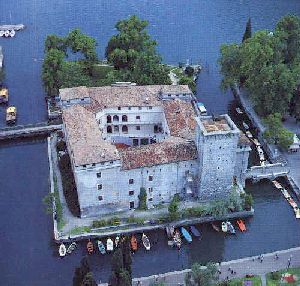 As you approach it from Lake Garda, the solid square bulk of the Rocca looms up before you. It used to guard the little harbour, a few steps from the town hall. A drawbridge connects it to the terra firma giving the place the picturesque resemblance of a sea town.
From on high, instead, you can see in one glance the whole of the bay, the mountains rising steeply from the water and the little town, once surrounded bybattlementedwalls stillvisible to the west, protected by the Rocca from dangers coming from the lake.
The fort has been altered several times over the centuries, a sign that Riva and the whole of the Trentino Garda area was the subject of continual dispute and conflict in a succession of dominations: the Della Scala, the Carrara, the Visconti, the counts of the Tyrol, Venice, Maximilian I and lastly in the sixteenth century Clesio, Prince Bishop of Trento. Although it fell into decay during the last century, the complex still preserves a typically medieval appearance: moats full of water, corner towers incorporated in the main buildings forming a fortified quadrilateral, turreted avant-corps at the entrance with a drawbridge and portcullises. The whole is dominated by the powerful keep, the largest square keep in Trentino castles, with its base built on rock and probably dating from the beginning of the thirteenth century. Among manywars, one in particular has marked the course of Rocca di Riva's history. The war that broke out in the fifteenth century between Venice and the Visconti of Milan, allies of the Tridentine prince bishop, then the owner of the fortress. Seized and then recaptured by the two contestants, the Rocca was finally left in Venetian hands, in 1440, after a memorable battle in which the arrival of the Serenissima troops and galleons "overland" (they sailed up the Adige and were then dragged by thousands of oxen across Loppio, San Giovanni Pass and Torbole) has remained famous.
The Rocca did not escape the tremendous passing of the French in 1703 either. Its keep, in particular, was damaged by the dynamite used by Duke of Vendome. The Austrians turned it into a barracks in the nineteenth century.
Location: from Piazza Battisti across the drawbridge
Information: Tel. 0464/554490
Mysterious, solitary, exposed to the scourging wind and sun, the indifferent observer of the Marocche wasteland stretching out below it, Castel Drena is a square fort of Ghibelline walls with a very high tower in the middle. It stands on the top of a steep rocky mound above a gorge. On the whole it has preserved the grim countenance of medieval forts, in an essentially Romanesque construction built mainly for defence and as a garrison rather than a residence.
Castel Drena barred and guarded the only practicable valley pass between the Valle del Sarca and Cavedine, along which ran the important road connecting Garda with Vezzano and the Terlago and Trento road junction. The tower of the keep rises to a height of 25 metres and it is 7 metres wide at the base. Entirely built of large ashlar stone and protected by two curtain walls, in the Middle Ages it would seem impregnable, built as it was in a dominant position on the crag. The outer ward, between the keep and the curtain wall, is dominated by a large wall round the whole of the length of which runs the wall walk. The crag rock outcrops everywhere: the steps of the Chapel of San Martino are cut in it. Recent restorations have been carried out chiefly on the lord's residence with a large arch, a small Gothic doorway, twin doors and a cistern.
The place is very old. It was probably a prehistoric hillfort and then a paleomedieval fortress. The history of the castle begins in the 12th century when the powerful D'Arco lords bought it from the Sejani of Dro. They fortified it and turned it into a bridge-head. In the War of the Spanish Succession, at the beginning of the eighteenth century, the castle followed the fate of many other Trentino castles. It was sacked and set on fire by General Vendome's French soldiers and in the end abandoned.
Location: from Padergnone, on the Gardesana Occidentale 45 bis state road, then down the Cavedine Valley 84 provincial road, and from Dro up the Marocche landslide. Open all year.
Information: Tel. 0464/541170
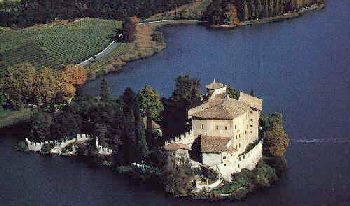 Situated in an extremely romantic setting where the architecture comes close to the water, the mountains, a wild kind of marsh vegetation and slopes cultivated with vines, Toblino is one of the jewels of the Trentino castle heritage.
The almost unspoilt environment contributes in making this castle even more exceptional, built in the 12th century on a rock outcropping on the shores of Lake Toblino. Apart from its beauty the castle owes its fame to the many legends associated with it, some of literary origin and relatively recent. According to the most famous legend, in the 1600s Toblino was the place of pleasure of Claudia Particella, daughter of Lodovico di Fossombrone, and Carlo Emanuele Prince Bishop of Trento and the last of the Madruzzo family, a story with an unhappy ending. The little peninsula is a very old site, once occupied by the Tublinates, as recorded in the 3rd century epigraph walled under the northern portico northwards. The castle is probably a development of a prehistoric hillfort and Roman site. Like their neighbours in Castel Madruzzo, the lords of Toblino were always administrators to the prince bishop of Trento, a loyalty that was often the cause of dispute with their nearby vassals, the restless lords of Castel Campo into whose hands Toblino passed in the 13th century. So the castle belonged to princely constables and, under Cardinal Clesio and later prince bishops of the Madruzzo family, it was restored and rebuilt on Renaissance lines to become a lord's residence and farm.
A low battlemented wall protects it from the water and surrounds as much of the building and peninsula as possible. The cylindrical tower on the right reminds one of Castel Campo. (3n the left the baroque chapel is dedicated to Saint Anthony. The castle layout is square with a rather dark inner ward. The Calavino red stone arches of the portico, loggia and Gothic door blend well with the sixteenth centurywooden balustrade of the gallery under the eaves. It is a splendid combination of an alpine rustic and Renaissance castle building.
Location: off the Gardesiana Occidentale 45 bis state road
Information: Tel. 0461/864036
The castle is difficult to find unless you are well acquainted with the winding road through the wood leading to it. It is also difficult to see as it is tucked away in the vegetation of the valley floor of Campo Lomaso. The castle is deceiving to the eye. The rather solemn and somewhat romantic turreted bulk rises on the edge of the Lomaso plain, but in point of fact it is anchored to a rugged hill between the Duina and the Rezola streams. This small peninsula, joined to the terra firma by the green fields of Campagnola, is a difficult place to reach.
It was founded in the IIth century, on the area of a hillfort used as a place of refuge by the inhabitants of western Lomaso. When the proud Lomaso Campo family settled there, the castle acquired considerable military prestige, situated as it was at the crossroads between the Valle del Sarca and Trento. In 1423, in the war between Venice and Milan, Francesco di Campo allied with the Visconti, together with the prince bishop and the d'Arco family. Sixteen years later Castel Campo was destroyed by Paride di Lodron, an ally of the Serenissima. Then the castle was taken over by the family of Prince Bishop George of Hack, who reconstructed it and later sold it to the Trapps. Further restoration work was carried out in the nineteenth century. The two main features of the castle are the towers: the first, cylindrical and three metres thick, is the oldest and was raised and decorated in the eighteenth century. The semicylindrical keep to the west is smaller. Late sixteenth century courtly frescoes are preserved in the top of it. The whole of the inside of the castle was painted by Carlo Donati in the twentieth century with late-Gothic revival and post art nouveau decorations and this has lightened its architectonic structure.
Location: from Ponte Arche along the Riva del Garda - Ponte Arche 421 state road, you reach Campo Lomaso after 3 km.
Turn into via Prati to the church and then along a country lane.
Information: Tel. 0465/71465
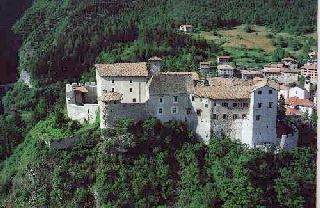 The compact bulk of Stenico can be seen from a distance as you approach it along the winding roads of the Giudicarie. The castle is a significant example of a mixture of styles, showing all the various transformations and in particular those of the 13th and 14th century. The succession of assorted buildings and wards is incorporated in the southern curtain wall and enclosed by a strong external curtain wall towards the north. The Romanesque building, looking onto the outer bailey, is depicted in the month of January of the famous cycle frescoed in the Aquila Tower of Castello del Buonconsiglio in Trento. The same fresco portrays the Fune tower, the oldest part of Castel Stenico: small dark gloomy rooms used as prisons. It is also called Bozone's tower after the name of the first feudal investiture, in 1163, on the development of a hillfort and former Roman settlement and paleo-Christian basilica. The thirteenth century chapel of San Martino, looking onto the first ward, contains a precious cycle of sacred frescoes of the Romanesque school. Between the first and second ward is the lovely Renaissance loggia built by Clesio. Then, looking onto the second ward, there are buildings backing onto the Romanesque residence built in the fourteenth and fifteenth centuries, when Stenico was securely in the hands of the episcopal principality after secular disputes with the Campo family. Prince Bishop Hinderbach gave unity to the castle by building, almost from scratch, the residence that bears his coat of arms. Hinderbach ordered the fresco, depicting Charlemagne, Saint Igilius and Bishop Albert I, in the Council Room above the Great Hall, which records the donation of the stronghold to the bishop by the emperor and the castle's construction.
Clesio, apart from the above mentioned Clesian loggia, extended and renovated Castel Stenico further: the Room of the Black Fireplace and the Medallion Room with allegoric figures. Clesio also built the new residence towards the east. With the secularisation of the principality, the castle passed to the Austrian Empire and new buildings were made along the perimeter of the south wall.
Location: from the square of Stenico a few minutes' walk up an easy road in the wood. Open all year.
Information: 0465/71004 0461/233770
The castle stands remote on the top of Sant'Antonio hill, and yet it is built in such a way that it can "spy" on all the villages in the area, from Pieve di Bono to the shGres of Lake Idro. The castle's most distinctive remaining features are the granite stonework and the arrow slits, loop-holes and powerful thickwalls. It had few windows, only six of which remain, and these were also suitably designed for battle. The main feature of Castel Romano, which is a challenge to time despite the Italian cannon-shots in 1915-1918, is a castle tower built on a polygonal plan with an entrance facing south, about six metres high and originally fitted with a drawbridge. The fortress was built in the 12th century, using exquisite militaryworkmanship. In the following centuries it underwent numerous alterations due to the damage suffered during military action and to adapt it little by little to the newwar weapons. It is a castle tower which reflects the aggressive, restless and obstinate spirit of the lords that inhabited it, the counts of Lodron. The first reports on Castel Romano date back to the second half of the thirteenth century. At that time it belonged to the d'Arco, but soon this family entered into a dispute with the Lodrons for the supremacy of the Giudicarie. Sudden attacks, occupations and liberations quickly followed one another until, towards the end of the fourteenth century, the stronghold became the property of Paride, the most authoritative member of the Lodron family. During the first half of the fifteenth century, this area of southern Trentino was stained with the blood of the war between Venice and Milan which naturally involved the Lodrons and Castel Romano. The Lodrons sided with the Serenissima, whilst the d'Arco family and the prince bishop of Trento stood by the Viscounts of Milan. The battle between the two families started all over again and was more bloody than ever. Despite these continual and bloody battles, the castle remained in the possession of the Lodron family.
Location: on the 237 state road, north of Creto, at Strada take the provincial road to Por, after 1.5 km there is a small square and from there it is a few minutes' walk up the lane.
Information: Tel. 0465/674001
Back to Castles Index

How to contact us 
Peschiera del Garda
Milan
Rome
Sorrento
Venice
Taormina
Massa Lubrense
Budoni
Malcesine
Bardolino
Riva del Garda
Selva di Val Gardena
Castellammare di Stabia
Passo del Tonale
San Pietro (Naples)
Garda (Verona)
Perca
Savoca
San Vincenzo
Tremezzo
Ostuni
Limone sul Garda
Colleoli
San Cassiano (Badia)
Santa Maria di Leuca
Ugento
Florence
Naples
Campofelice Di Roccella
Desenzano del Garda
Savelletri
Amalfi