Provinces: L’AQUILA, FROSINONE and ISERNIA
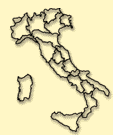
Number of communes: 18, in four geographical areas belonging to three regions (Abruzzo, Molise and Lazio) and three provinces (L’Aquila, Isernia and Frosinone).
Area: 44,000 hectares + 60,000 hectares in other protected areas.
Information
Viale Tito Livio 12, Roma, tel. 06 35403331
Getting there
The A 25 Rome-Pescara motorway, exit at the Pescina toll booths on to the SS 83. After going round the south edge of the Fucino plain, the road turns towards the area before the park, touches Gioia dei Marsi and climbs. You enter the park from Gioia Vecchio. From the south, you reach the park on the SS 509 from the Comino valley.
Geography
The Abruzzo National Park is in the mountainous centre of Italy and is a kind of high altitude barycentre with complex, diverse natural properties. It covers areas of high valley (over 1000 metres) and rises to 2249 m on Mount Petroso. The dominant geographical features are the mountains and the whole associated system of the river or rain stream valleys of the Sangro, Sagittario, Melfa and Giovenco. The water system of the river valleys and lake basins, both natural and artificial, and regular and irregular; and glacial and karst features (caves, dolines and swallow holes) all work together to shape the environment.
Excursions
Marked routes leading visitors through particular areas start from all the towns in the park. There are 150 routes, most of them quite easy and taking about an hour. Some are more demanding and require some training, but what is particularly required is the spirit of discovery.
Description
Although it is predominantly mountainous, the Abruzzo National Park is an integrated complex of natural habitats and animals in which there are also small local communities with strong cultural roots and traditions which are still very much alive today. The heart of the park is the primigenial Camosciara, a true natural sanctuary. This mountain amphitheatre is covered in many places with thick woodland, inhabited by the animals which are the symbol of the park, bounded by two valleys, the Fondillo and the Iannanghera, and crossed by the River Scerto and other waterways. About 2000 hectares of it is completely protected. The forest dominates the whole park, covering an area of almost 21,000 hectares. The most common tree is the beech but there are other species besides adding variety and interest – the mountain maple, the ash, the mountain sorb and the black pine of Villetta Barrea. The park’s most valuable asset, and which it exists to protect, however, is its wildlife, including the Marsica brown bear, the Abruzzo chamois, the Apennine wolf and the golden eagle. Nowadays there are 40 species of mammals, 300 kinds of birds and 30 different reptiles and amphibians.









 Provinces: L’AQUILA, FROSINONE and ISERNIA