
Italian Tourist Web Guide © 1996/97 by ITWG.COM
(Provided by Azienda di promozione turistica del Trentino)
 Back to Trentino Index
Looking at the brownish red colour of the porphyritic rocks one realises at once that the Lagorai chain originated from the upheavals and volcanic eruptions of millions of years ago. Today the mountains are the kingdom of the Great Silence, a paradise for trekking enthusiasts in search of open spaces and tranquillity and an invigorating full immersion in nature .
A green highland of gentle profiles, dotted with small villages in which life runs smoothly keeping in step with the seasons, along the old road between Trento and Feltre. This is Tesino and the southernmost end of the Valsugana.
Here the welcome is straightforward and sincere. Your holiday will be influenced by the landscape which induces you to relax and contemplate. Those who wish can cross the meadows and fields and, within just a few kilometres, reach the great Lagorai and Cima d'Asta mountains where the front line between Italy and Austria ran during the First World War. The trenches, huts, caves and communication trenches remaining from that time are a further point of interest. The wild steep slopes of these mountains, rich in water, flora and fauna, alternate with other gentler and more accessible ones on which flocks of sheep graze up to over two thousand metres.
Rarely visited because of the lack of supporting facilities, such as modern alpine refuges, the Lagorai chain, dotted with large and small alpine cowsheds in its endless valleys and dells, and the nearby Cima d'Asta are ideal for people fond of hiking in a huge wilderness.
The paths running along the sides of the mountains afford easy walks as do the ridges. Many tracks follow the routes trodden by Mesolithic hunters, of whom various signs have been found, or in more recent times by shepherds and "clomeri", the hawkers who went from valley to valley. Besides your travelling companions, deer and mountain goats, the royal eagle and marmots will keep you company in the great and almost sacred enveloping silence.
A.P.T. LAGORAI DELLA VALSUGANA ORIENTALE E DEL TESINO
38053 Castello Tesino - Tel. 0461/593322 - Fax 0461/593306
38051 Borgo Valsugana - Tel. 0461/752393
38059 Strigno* - Tel. 0461/763668
ASSOCIAZIONI PRO LOCO:
38050 Telve
38050 Telve di Sopra
38051 Torcegno
* Open in the tourist season
The Levico and Caldonazzo lakes and their effluent, the Brenta mountain torrent that flows down to the Adriatic sea, influence the microclimate of this valley in which constant humidity gives the vegetation a special green colour.
Valsugana, one of the most important valleys in Trentino from a historic and administrative point of view, is surrounded by the Folgaria, Lavarone, Luserna and Vezzena highlands and the southern slopes of the Lagorai mountain chain.
For centuries it has been the natural exit towards the Venetian plains and sea, an extremely important and strategic road for commercial and tourist traffic. The capital of the upper part of a medieval castle, rich in buildings constructed during the Renaissance period. From Pergine the road winds through Valle dei Mocheni, a green Valsugana is Pergine, the third largest alpine corner set among the town in Trentino, Iying at the foot of mountains with a natural and urban environment of great interest. The valley still preserves the original language and customs of the German population who settled here in the Middle Ages.
A few kilometres away, Lake Caldonazzo has become a tourist resort of great importance and not only for Valsugana. On the shores of t the lake many modernly equipped campsites host tens of thousands of tourists every year, mostly Belgians and Dutch. Many hotels and apartments are also available. Similar attractions, such as sailing and windsurfing schools, exalt the tourist offer of the other nearby lake of Levico. The village, Iying on the shores of the lake, has been renowned as a spa resort since the dawn of tourism and was patronised by the nobility in the late nineteenth century, as were Roncegno and Vetriolo where other sources of mineral water flowing from the Lagorai rocks boast curative properties. Lakes and plains, but also mountains. Panarotta is a natural balcony over the whole of Valsugana, a captivating viewpoint towards the Folgaria and Lavarone highlands, Vigolana and Trento itself.
A.P.T. TERME DI LEVICO, VETRIOLO E RONCEGNO - PANAROTTA 2002 - LAGO DI CALDONAZZO
38056 Levico Terme - Tel. 0461/706101 - Fax 0461/706004
38050 Calceranica al Lago - Tel.0461/723301
38052 Caldonazzo* - Tel. 0461/723192
38057 Pergine Valsugana* Tel. 0461/531258
38050 Roncegno* - Tel. 0461/764028
38050 S.Cristoforo al Lago* - Tel. 0461/531119
38050 Tenna* - Tel. 0461/706396
CONSORZIO PRO LOCO "VALLE DEI MOCHENI"
38050 Sant'Orsola Terme - Tel. 0461/551440 - Fax 0461/551030
CONSORZIO PRO LOCO "ALTOPIANO DELLA VIGOLANA"
38040 Vattaro - Tel. 0461/848350 - Fax 0461/848050
* Open in the tourist season
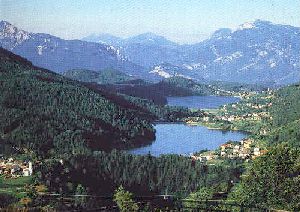 The Altopiano di Pine and Valle di Cembra are geographically close to each other, but they are very different in conformation and in traditions, uses and customs. Even the most distracted traveller will notice the contrast between the spacious Pine highland and the wild ruggedness of Valle di Cembra, a furrow cut by the Avisio torrent between impervious slopes only impassable in appearance.
The Altopiano di Pine is known especially for the Mountain Sanctuary
where Mary appeared to a shepherdess and it has been the destination of pilgrims and a place o prayer for over 250 years. One is struck by the spiritual atmosphere breathed here in this day and age.
Villages and hamlets, some with just a few houses, are scattered all over the green highland in the centre of which two lakes, Serraia and Piazze, gaze at the sky with large cobalt-blue eyes from among the fir trees. A festival of nature completed with humid and peat conservation areas like Laghestel, a natural beauty and landscape reserve.
If gentle best describes the Pine highland, harsh is the most fitting word for Valle di Cembra with its steep gorges of porphyritic rock. It is an environment where no imagination is needed to understand the toil and sacrifice man has had to bear living and working in a niggardly agricultural area like this.
The sides of the mountains, almost down to the pebbly banks of the torrent, are made of terraces where vines have always been cultivated, chiefly Muller Thurgau and Schiava, to produce a really top quality wine. Until a few years ago the farmers carried the soil, for the trellised vines, in baskets on their backs up the steps from one terrace to another. This endless job had to be repeated after every violent thunderstorm that washed away the soil from the side of the mountain.
The porphyry, called "red gold", quarried from the mountains and exported all over the world, has made up for the agricultural poverty. Valle di Cembra is also famous for the Segonzano Pyramids, called "Omeni", pinnacles of earth tens of metres high, standing erect like sentinels, incredibly sculptured by natural erosion over thousands of years. The valley is also renowned for its grappa which, until a few years ago, was distilled in the cellars of the humble dwellings. Sometimes the stills were taken to the woods, just outside the villages, during the night because making grappa was prohibited. People from all over Trentino climbed to Cembra to buy the legendary grappa. Along with those stills a part of the history of our land has disappeared.
A.P.T. DELL'ALTOPIANO DI PINE' E VALLE DI CEMBRA
38042 Baselga di Pine - Tel. 0461/557028 - Fax 0461/557577
38034 Cembra - Tel. 0461/683110 - Fax 0461/683110
38047 Segonzano*
* Open in the tourist season
As if in the centre of a green ocean, the eye can gaze all around. The fields and meadows are surrounded by forests, dotted with cowsheds and farmhouses, marked by the crude evidence of human madness materialised in the imposing ruins of the front line between Italy and Austria during the Great War.
On the borders with Asiago and the Seven Communes, the Folgaria, Lavarone and Luserna highland is a huge table, Iying about one thousand metres a.s.l., with a good climate and sun all day.
Lavarone, with its attractive lake, the cleanest in Italy, welcomed the first tourists of the Viennese upper class and nobility in the last century. It became so well known that even Sigmund Freud heard about it and came to enjoy his holidays here.
A few kilometres away another part of the huge highland is dotted with the hamlets of Folgaria, another popular resort for decades, also with an illustrious personality in its golden register of guests. Cesare Musatti, who was sent to Serrada as a child by his doctor because he was, as he writes, "a seven months' child and said to be frail". This great Milanese, the father of Italian psychoanalysis, remained attached to this area for the rest of his life.
Luserna, the other highland village, is inhabited by Cimbrian people, a proud ethnic minority of German origin, who have survived in an era of general unification, guardians of uses, traditions, customs and a language all to be discovered. In the woods behind the houses and further up towards the first cowsheds, you can find, in summer, lovely edible mushrooms that are taken to the market in Trento every morning.
The highland's environment and great open spaces tempt you to go walking and trekking, following history once again. This area was strategic in the First World War and the Austro-Hungarians fortified it with a mighty system of trenches, communication trenches, casemates and bastions. Today, the ruins of these and some forts can still be visited along the Path of Peace which crosses the whole of Trentino following the front line where the Alpine soldiers and kaiserjaeger faced each other.
A.P.T. DEGLI ALTIPIANI DI FOLGARIA, LAVARONE E LUSERNA
38064 Folgaria - Tel. 0464/721133 - Fax 0464/720250
38046 Lavarone - Tel. 0464/783226 - Fax 0464/783118
38044 Carbonare di Folgaria* - Tel. 0464/765377
38040 Luserna* - Tel. 0464/789641
38060 Serrada* - Tel. 0464/727156
* Open in the tourist season
 Crossing Vallagarina, the old route between northern Europe and the Italian plains, the eye is struck by the harmonious succession of castles and rows of vines in a gently rolling landscape with mountains on either side following the characteristic glacial conformation.
The line of defence along which the castles were built to control the strategic compulsory passage is clearly defined. Castel Beseno, a veritable fortified citadel, Castel Pietra just south of it, Castel Noarna and lastly Sabbionara d'Avio. The bottom of the valley is covered with endless rows of vines that produce white wines, spumantes and red wines, including the famous Marzemino mentioned by Mozart in his opera Don Giovanni. The great Salzburg musician linked his name to Rovereto when he performed his first public concert there at a very young age. Homage is paid to Mozart every year with a cycle of concerts. Suspended between this and a thousand other ancient memories, over the centuries, the town has consolidated its own personalised cultural pole open to the south and counter to a more Nordic Trento. In its historic centre, Rovereto is paved with alleys, small squares and porticoes that seem to be stolen from Venetian architecture, like the sober mansions of the silk merchants and artisans (silk-worm raising used to be a flourishing activity in the whole of the valley).
A museum, bearing the name of an illustrious Roveretan, Fortunato Depero, the leader of futurism, occupies the house where he lived. Other celebrities, evidence of the cultural vitality of this town, were the musician Riccardo Zandonai and the philosopher Antonio Rosmini.
Among the other features are the great Bell of the Fallen and the War useum housed in Rovereto Castle.
Recently a new attraction of current scientific interest, or mere curiosity, has been created by the Jurassic Park effect. Some tracks with prints left by dinosaurs millions of years ago have been found on the slopes of Mount Zugna, a few kilometres south of Rovereto.
A.P.T. DI ROVERETO
38068 Rovereto - Via Dante, 63 - Tel 0464/430363 - Fax 0464/435528
38060 Brentonico Tel. 0464/395149 - Fax 0464/395l19
38060 Vallarsa - Fraz. Anghebeni* - Tel. 0464/869098
*Open in the tourist season
On his journey through Italy in 1786, Johann Wolfgang Goethe was enraptured by the beauty of Lake Garda. As a northman he described the climate with enthusiasm, marvelling at the lemon blossoms and palms.
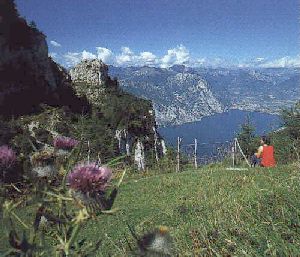
This huge bowl of glacial origin with Arco, Riva and Nago-Torbole, the threshold and border between the Dolomite area and the south, with its typically Mediterranean climate, which is mild even in winter, has obviously attracted travellers crossing Europe since the end of the last century . The vegetation is rich. Olives, citrus fruits, palms and oleanders follow one another mirrored in the waters of Italy's largest lake surrounded by sheer mountain cliffs creating a unique landscape.
It is in this synthesis of water and rocks that a thousand opportunites for leisure can be found, all in the presence or with the complicity of the main subject, the lake. Sailing or windsurfing on the waves ruffled by the daily "ora", the wind that turns this area into a marvellous place for regattas. Or free climbing on the smooth rock faces at the Spiaggia delle Lucertole, or parapenting off Mount Baldo and flying for hours over the lake and a thousand other possible excursions.
The areas close to Garda also benefit from this wonderful climate. Indeed Arco, immediately inland from Riva, used to be a famous "Kurort" a renowned health resort in Hapsburg times. The Valle dei Laghi is also dotted with stretches of water like Cavedine, Toblino and Santa Massenza, places in which tourism has developed indirectly, but nonetheless rich in contents and incentives .
All places to be explored, like the Valle di Ledro traversed by Garibaldi who, at Bezzecca, pronounced the historical "I obey", stopping his advance in the Tyrol during the third War of Independence. The area is also known for Ledro Lake in which a lake dwelling village was found dating back to the Bronze Age two thousand years before Christ.
Here, too, one has a precise idea of the past, of the size and prerogatives of a "transit land" peculiar to Trentino.
A.P.T. DEL GARDA TRENTINO
38066 Riva del Garda - Tel. 0464/554444 - Fax 0464/520308
Telex 400278 RIVTUR I
38062 Arco - V.le Palme, 1 - Tel. 0464/516161-532255 - Fax 0464/532353
38069 Torhole - Tel. 0464/505177 Fax 0464/505643
38074 Dren* - Tel. 0464/541220
38074 Dro* c/o Municipio Tel. 0464/504313
38060 Nago* - Tel. 0464/505382
38060 Tenno* Tel. 0464/500848
CONSORZIO PRO LOCO "VALLE DI LEDRO"
38060 Bezzecca - Tel. 0464/591222 - Fax 0464/591577
CONSORZIO PRO LOCO "VALLE DEI LAGHI"
38070 Padergnone - Tel. e Fax 0461/864400
* Open in the tourist season
The waters flow from the springs at a constant temperature of 27.5 degrees and already in Roman times they were known for their therapeutic properties especially good for skin diseases.
The Comano springs are the main resource of the whole area of Banale, Bleggio and Lomaso. The work of catering and accommodation in hotels, apartments and rented houses flanks and integrates, in a well balanced partnership, the work of the farmers in the fields. The atmosphere and countryside make a holiday here pleasant and relaxing.
The whole area gravitates around the modern spa centre in the heart of a very large green public park on the banks of the Sarca torrent. The therapies depend on the water that is low in mineral content but rich in calcium bicarbonate and magnesium. However, in recent years, the area
has developed a holiday offer linked to nature and the environment and bent on rediscovering the rural civilisation.
How? By entering the daily life of the large and small villages of Banale, Bleggio and Lomaso, three small highlands surrounding Comano. Walking through the countryside and among the houses, discovering their great and small history, you can appreciate the features and products of this land. Cheese (the area is an important dairy farming centre) or Bleggio walnuts, legendary for their taste, potatoes grown in the geometric Lomaso fields, all undoubtedly justify buying a small supply to take home. A holiday up here can, for instance, take us back to our school days when, in Dasindo, a small hamlet of Lomaso, we discover the plaque marking the house of the poet Giovanni Prati. Or it can encourage us to investigate the existence of our distant ancestors by visiting the lake dwelling, brought to light in the Fiave peat-bog, an archeological site of rare wealth and interest.
A.P.T. TERME Dl COMANO DOLOMITI DI BRENTA
38077 Ponte Arche - Tel. 0465/701465 - Fax 0465/702281
38071 Bleggio Superiore - Loc. S. Croce * - Tel. 0465/779559
38075 Fiavè* - Tel. 0465/735268
38078 S. Lorenzo in Banale* - Tel. 0465/734040
* Open in the tourist season
Back to Trentino Index
Continue....

How to contact us 