|
Hotel |
 |
|
|
 |
|
Restaurants |
|
|
|
|
|
Cities |
|
|
|
|
|
eShop |
|
|
|
|
|
Look at... |
|
|
|
|
|
VENEZIA Tourist Guide and Information
|
Venice
|

|
|
| HISTORICAL INFORMATIONS |
At the fall of the Roman Empire barbarian hordes descended from the north of Europe, bringing death and destruction. The inhabitants of the Venetian cities, to escape from the ferocity of the Huns and Vandals, took refuge in the islands of the Adriatic lagoon: thus it was that around 450 AD Venice was born, the "city of islands," subjected to Byzantine influence and governed by a duke, or Doge, elected by a popular assembly.
Wise use of diplomacy and arms soon led to Venice taking control of the coasts of Istria, Dalmatia and Puglia and to becoming a true power, increasingly independent of Byzantium.
The splendor of what came to be called the "Serenissima" Republic, however, only began in 1202, when the Doge Enrico Dandolo furnished important help to the knights of the fourth Crusade in the conquest of Constantinople.
From the division of the Byzantine spoils, the Serenissima gained immense riches, allowing it to expand its own commercial horizons: its ships dominated the Mediterranean as far as the Middle East and returned to the lagoons laden with precious merchandise not found in Europe. |

Mistery and charm, beauty and atmosphere
|
Venice reached the heights of its power at the beginning of the fifteenth century, after having defeated the Duke of Milan and having conquered many cities of northeastern Italy, becoming along with Milan and Florence one of the principal powers of the Italian peninsula.
From this time began the slow but inexorable descending spiral of the Serenissima. From 1415 the Turks conquered the Venetian colonies in the Middle East one by one, while at the end of the century the Portuguese, circumnavigating the Cape of Good Hope, opened a new route to the Indies, taking from the Venetians commercial primacy in those areas.
The final blazing military victory was that of Lepanto, in 1571, against the Turkish fleet. Then the descent became unstoppable. In 1797 Venice lost its independence. It was conquered by Napoleon Bonaparte who successively ceded it to the Austrians. The Serenissima Republic didn't exist any more. Only seventy years later, in 1866, the Venetian territories would become part of the emerging Kingdom of Italy. |
|

|
Art and Culture
|
|
| Byzantine, Gothic and Renaissance are the principal reference points for the artistic development of Venice. The Byzantine style characterized the first centuries of the city. Marbles and columns arrived from the Middle East at the lagoon city, where projects for the construction of the first great buildings were directed by masters from the East and from Ravenna. The Basilica of San Marco is a masterpiece of Romanesque-Byzantine style, the center of Venetian life for all times. Today few buildings remain from that period and their locations demonstrate clearly the early lines of the city’s development: from San Marco to Rialto and, along the borders of the Grand Canal, from San Zan Degolą to San Polo. Beginning in the second half of the thirteenth century the Gothic style affirmed itself in Venice, as it did in the rest of Italy's cities. Among its most vivid testimonies are the Doge’s Palace and the Ca' d'Oro (House of Gold). In the sixteenth century the Renaissance style left a strong imprint (Rialto Bridge), followed by Baroque, Rococo and Neoclassical. Throughout the city the testimonies of great Venetian masters are revealed in paintings from the fifteenth, sixteenth and seventeenth centuries.. |
|
|
How to arrive in Venice
|
|
| By car |
By plane |
By train |
Venice is accessible by car via the A4 highway (Turin-Milan-Trieste).
At Mestre the highway connects with a superhighway 11 kilometers in length (via "Ponte della Libertą," Liberty Bridge), that one traverses to reach the lagoon.
With the car, however, one cannot go beyond Piazzale Roma, where there is pay parking.
Another way of reaching Venice is to leave the car in the Mestre area and use public buses, which guarantee excellent connections with Piazzale Roma. |
The airport of Venice/Tessera, the "Marco Polo," is located 13 kilometers from the city and is served by most large international airlines. |
The Venice train station is called Santa Lucia and is located at the S. Lucia Quay, near the final stretch of the Grand Canal. It is served daily by Intercity and Eurocity trains. The Mestre station, on terra firma, is found in Piazzale Favretti. |
|
|
How to get around in Venice
|
|
| Vaporetti (steamers) and gondolas |
In Venice one can take a very normal taxi (Radio Taxi's number is 041/ 5237774) or one can rent a car. The only public means available for traveling in the center, however, are the canals: via water taxis (in service 24 hours out of 24), vaporetti, and traditional gondolas. The vaporetti and passenger-bearing speedboats can traverse only the largest canals, including the Grand Canal. Boats and gondolas, though, can insinuate themselves into the narrowest waterways and are advised for those who want to preserve a particularly romantic memory of the city.
Connections with the Lido (beach) and nearby islands are also guaranteed. |
|
|
Events
|
|
|
The Biennale (Biannual)
Art Show An international exposition of art that takes place every two years between June and October (the next appointment is for 2001). Works and displays by artists from around the world are exposed in a spacious site at the end of the Riva dei 7 Martiri and in the most important palaces of the city. The headquarters of the Biennale Association is in the Ca’ Giustinian.
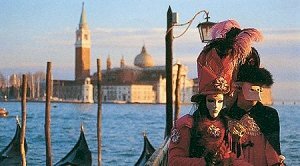 Carnival Carnival
Every year in February the farcical eighteenth-century Carnival comes alive in the piazzas and streets of the city. Open-air balls, theater representations and shows of every kind involve all of Venice, which is invaded by thousands of traditional masks. For the occasion, a special propitiatory rite is celebrated: the Venetians construct a dove full of streamers that, attached to a cable, flies through the Piazza San Marco from the Bell Tower to the Clock Tower. On its arrival it breaks open and from the flight of the streamers the Venetians can predict the fortunes of the upcoming year.
 Festival of the Redeemer Festival of the Redeemer
Every year on the third Sunday of July, Venetians celebrate the Festival of the Redeemer, in memory of the end of the plague of 1576. A boat bridge guides Venetians and tourists to the Church of the Redeemer while the Giudecca Canal fills with boats and gondolas decorated for the festivities. In the evening the historical palaces facing the Grand Canal are illuminated. The festivities end with an unforgettable fireworks spectacle over the water.
Film Festival
The international film festival takes place every year between August and September at the Cinema Palace of the Lido of Venice. The jury, always composed of great personalities of the film world, assigns the "Leone d'Oroī (Golden Lion) award to the best films in the competition.
Historic Regatta
The first Sunday of September the Grand Canal welcomes thousands of boats decked out in regalia and driven by crews wearing historic costumes. This display brings to life the regal atmosphere of the Serenissima Republic, for thousands of tourists from Italy and abroad.
 Marriage to the Sea Marriage to the Sea
Ascension Day, the Doge climbs into his majestic boat, the ģBucintoro,ī and is born to S. NicolŚ del Lido, followed by a fleet of boats decorated for the festival. Upon arrival he throws a wedding ring into the lagoon. On this day, in fact, the Venetians recall their indissoluble marriage with the sea. The celebrations include a historical parade of ships and boats on the Grand Canal and races among gondola drivers.
S. Maria Della Salute
The 21st of November Venetians celebrate one of their most popular anniversaries. They commemorate, in fact, the end of the plague of 1630, at which time the church of S. Maria Della Salute was built. A boat bridge leaving from San Marco and passing through the Grand Canal connects the neighborhoods (contrade) of S. MoisĖ and S. Maria Zobenigo to the opposite banks.
Venice Marathon
An official marathon in which famous athletes of international level compete. The course winds along the Brenta Riviera, ending in the Piazza San Marco.
Vogalonga
A non-competitive meet reserved for boats with oars. The course is about 30 kilometers long and traverses all the principle Venetian canals.
|
|
|
Food
|
|
|
Venetian cuisine has rustic origins, but trade with the Middle and Far East in the time of the Republic’s glory enriched and varied the stock of recipes. The galleons of the Serenissimo returned from long voyages carrying to the lagoon city salt, pepper, ginger, and even saffron from faraway China: spices at the time unknown, able to stimulate the fantasies of local cooks who brought to life a unique culinary artistry. Even today, Venetian cooking seems to renew the freshness of these fragrances with elaborately prepared dishes and refined tastes that often bring to mind the flavors of far-off places.
To eat Venetian means above all to taste the fish of the upper Adriatic. This is high-quality seafood of an almost infinite variety that, thanks to the fantasy of the recipes, lends itself to the most exquisite gastronomical variations. Crabs, polyps, cappesante, moeche, and cuttlefish are served in refined ways that reflect the particular sensibility and nobility of the Venetians. For example, granseola is a large crab that becomes a delicious antipasto on the tables of the Serenissima: it is thrown into boiling water and, at the end of its cooking, flavored with olive oil, salt, pepper, and a squeeze of lemon juice. A plate showing the Asian influence on the local gastronomy is, on the other hand, that of sardines in carp (in saor), in other words, braised and accompanied with onions, candied fruits, pine nuts, and vinegar, showing the typical alternation of salted and sweet foods. Another typical antipasto of the Venetian coast is the mixture of boiled fish and shellfish, such as canocchie, garusoli, and polyps. Among the main dishes worth mentioning are the delicate risottos, prepared with fish, shellfish, and vegetables. We recall black cuttlefish risotto, risotto with shrimp, with eel, with ghiozzi and cappe (clams and telline). Shrimp and granseole are also excellent for pastas, accompanied even by bigoi (desalinated anchovies). Among the second dishes are pan-fried cuttlefish, stewed eel, and all the catch of the Adriatic: sardines, rombi, moscardini, cefali. The Venetian ģfritter,ī made with expert technique, is internationally famous.
But there’s more than just fish on Venetian tables. Among the dishes that have made their gastronomy famous, we find liver Venetian style, probably the most noted of the Serenissima’s specialties that one can taste today in almost any part of the world. In practical terms this means liver sliced and cooked in a soffritto, a mixture of oil, onions, butter, and parsley: a dish that one is almost obliged to taste during a visit to Venice. Another famous dish is rice and bisi, or peas, which opened the Doge’s lunch on the day of the Festival of Saint Mark.
|
|
|
Nightlife
|
|
|
The principle places for Venetian nightlife are without a doubt La Fenice Theater and the Casino. La Fenice, finished in 1792 and often restored, famous throughout the world for representations of lyric opera, was recently destroyed by fire. While awaiting its reconstruction the lyric season and the ballet will take place at PalaFenice, on the Isola Nuova of the Tronchetto. For information and reservations call 0147/ 882211 (telephoning from Italy) or 39/ 6/ 32658010 (telephoning from abroad). The Casino of Venice, on the other hand, has two locations. That of the Lido, on the beachfront road called Lungomare Marconi, is open in summer. That of Vendramin Calergi Palace is open in winter. One can play roulette, chemin de fer, slot machines, etc. For information, call 041/ 5297111. In Venice there are also cafĖs and pubs where one can pass a pleasant evening in company. Here is an updated list.
Al Canottieri
San Giobbe Cannaregio 690
Tel. 041/ 717999
Birreria Frost
Calle delle Rasse, Castello 4540
Caf Blue
Dorsoduro 3778
Tel. 041/ 5237227
Centro Sociale Morion
Salizada S. Francesco della Vigna, Castello 2951
Tel. 041/ 5205163
Circolo ai Miracoli
Campiello dei Miracoli, Cannaregio 6075
Da Codroma
Dorsoduro 2540
Tel. 041/ 5246789
Daikiri Pub
Rio Terą della Maddalena, Cannaregio
Tel. 041/ 5240758
Devils Forest Pub
Campo San Bartolomeo, Rialto
Te. 041/ 5236651
Lanterna Blu
Campo San Lorenzo, Castello 5063
Tel. 041/ 5235571
Le Bistrot de Venise
Calle dei Fabbri, San Marco 4685
Linea dOmbra
Punta della Dogana, Zattere-Dorsoduro 12
LOlandese Volante
Campo San Lio, Castello 5658
Tel. 041/ 5289349
Martini Scala Piano Bar
Campiello San Gaetano 1980, San Marco
Tel. 041/ 5237027
The Fiddlers Elbow
Corte dei Pali, Cannaregio 3847
Tel. 041/ 5239930
|
|
|
|